From smoother-looking skin to recovery after exercise, light therapy is worth a closer look. Here are the findings that matter—and what they mean.
01 / Skin & collagen
A closer look at smoother skin.
36%lower measured wrinkle roughness
In one controlled trial, the combined red + near-infrared group improved by 36% from baseline at the three-month follow-up.
Baseline100
Follow-up64
633 + 830 nm · 8 sessions over 4 weeks Group average versus baseline; not a Torch result.
Study details & sources
Lee et al., 2007. A randomized, sham-controlled, split-face trial assigned 112 adults to four groups; 76 completed the study. The 36% figure is the combined-light group's change in measured roughness at three months after treatment, not a reduction in wrinkle count or an effect measured against placebo.
Skin samples also showed increased collagen and elastic fibers. Many participants dropped out, and most were women aged 35–55, which limits how broadly the findings apply. The devices and treatment doses differ from this torch.
Another controlled trial, Wunsch & Matuschka, 2014, enrolled 136 volunteers and found improvements in skin roughness and ultrasound-measured collagen density after 30 sessions. It used broad-spectrum equipment and 23 non-randomized, untreated controls; the study had manufacturer involvement.
A small split-face study reported fewer acne lesions on the red-light-treated side after eight weeks of treatment.
28 volunteers · Twice-daily treatment
The 2024 acne guideline found insufficient evidence to recommend light devices. Many trials also use blue light, which this torch does not have.
Study details & sources
Na & Suh, 2007. In a randomized split-face study, 28 volunteers used red light for 15 minutes twice daily for eight weeks. The treated side showed improvements in inflammatory and non-inflammatory lesion counts. The comparison was an untreated side, not sham light.
The wider picture: the 2024 American Academy of Dermatology guideline found insufficient evidence to recommend laser and light devices for acne. Promising individual trials do not settle that question.
A 2024 review found a small average improvement in strength recovery when light was applied before exercise.
Pre-exercise light therapy · Different devices and doses
Results varied, and the physically active subgroup did not show a significant benefit.
Study details & sources
2024 systematic review and meta-analysis. The review included 34 randomized trials and reported a small pooled effect of pre-exercise photobiomodulation on strength recovery: standardized mean difference 0.24 (95% confidence interval 0.10–0.39). This is a statistical effect size, not “24% better recovery.”
A useful counterpoint: a placebo-controlled study of 12 men using 660/850 nm LEDs after sprint exercise found no significant advantage for soreness, jump performance or measured recovery biomarkers. Matching wavelengths alone does not establish the same results.
A 2025 umbrella review found moderate-certainty evidence for improved function in knee osteoarthritis.
An umbrella review brings multiple reviews together. The knee-function finding concerns clinical light treatments.
Evidence for pain relief was weaker. This does not establish that the Torch treats arthritis, joint pain or inflammation.
Study details & sources
Son et al., 2025. The review covered 15 meta-analyses across many conditions. For knee osteoarthritis, it reported a moderate-certainty improvement in disability/function, with an equivalent standardized mean difference of 0.65 (95% confidence interval 0.14–1.15).
Its knee-pain finding was much smaller and supported by lower-certainty evidence. The authors called for better trials and standardized protocols. Results from professional light and laser devices cannot be transferred directly to a handheld consumer torch.
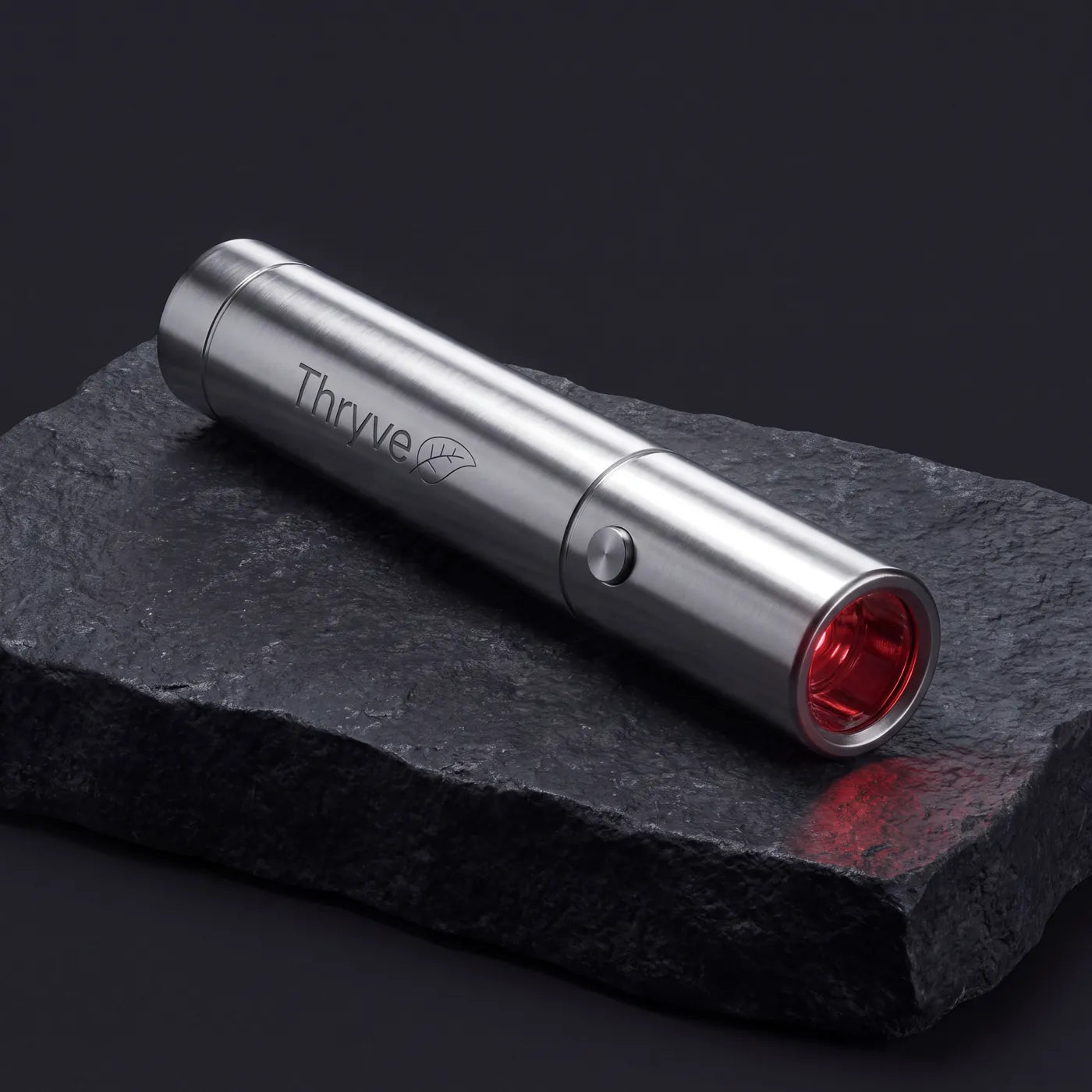
The Torch brings 630, 660 and 850 nm light into one portable device. Those specifications describe its light—not a clinical outcome. No clinical study of this specific torch is presented here.
Three wavelengths / One button
Meet your everyday torch.
Stainless steel. A travel-ready kit. Ships from Texas.